
NIIMBOT M2 300 DPI Thermal Transfer
4.4Editor score
300 DPI thermal printing
Rechargeable battery included
Multi-material support
This guide compares the top 10 label printers for laboratory environments, evaluating durability, connectivity, print quality, and sample tracking features for
Choosing the right label printer for laboratory use is essential for maintaining accurate sample tracking and equipment identification. Reliable devices must withstand harsh conditions while delivering clear, durable text that lasts through chemical exposure and temperature changes.
We evaluated ten leading models based on print resolution, connectivity options, and compatibility with lab-specific materials. Each product offers unique strengths for identifying tubes, bottles, and instruments in busy research settings requiring precision and efficiency.
Each pick highlights key features like thermal transfer technology or Bluetooth connectivity to help you select the best fit. Please note that product availability and pricing may change, so verify details before making your final purchasing decision today.
4.4Editor score
4.6Editor score

4.3Editor score
The following table provides a side-by-side comparison of all ten laboratory label printers to help you quickly identify key differences in connectivity, print width, and intended use cases.


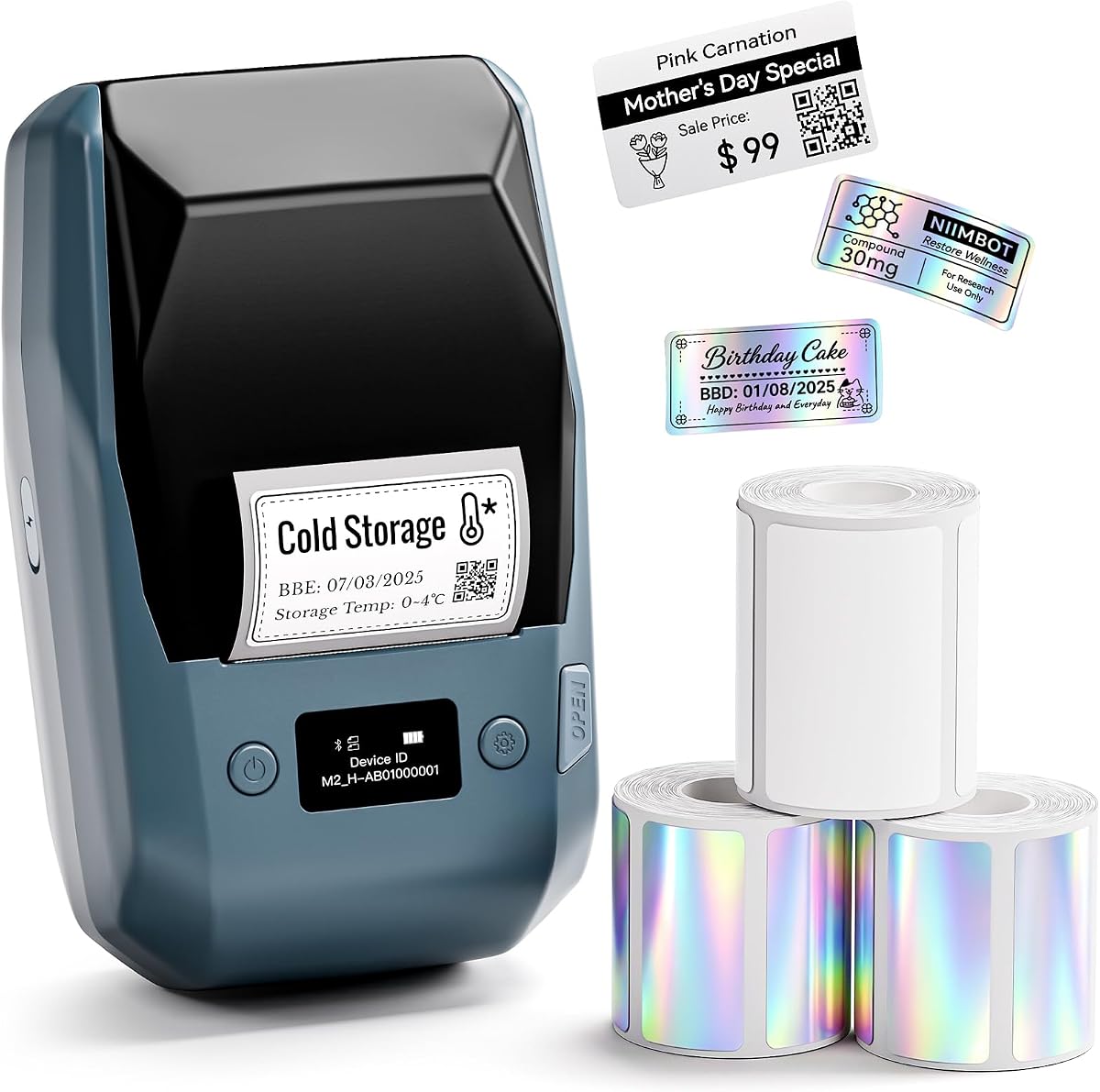
The NIIMBOT M2 Label Maker with Tape 3 Rolls stands out as an Editor's Choice for laboratory professionals needing a complete labeling solution. With a 4.6 rating, it combines thermal transfer quality with the convenience of an included tape bundle.
We may earn a commission when you buy through this link, at no additional cost to you.
Its 300 DPI resolution ensures crisp text and scannable barcodes essential for tracking peptide samples and reagent vials. The Bluetooth capability allows multiple users to pair devices simultaneously which streamlines batch labeling tasks in busy lab environments.
While the included VIP membership adds value, users should note that sustained heavy use will drain the rechargeable battery faster than expected. This is acceptable given the portability and ease of charging via Type-C port.
Researchers who need reliable asset tracking and sample identification without extra accessories will find this bundle ideal. It offers the best balance of immediate usability and professional print quality on the market today.
The inclusion of three rolls of laser silver tape means you can start labeling samples immediately without purchasing additional consumables.
Supporting up to ten paired mobile devices allows multiple lab members to share the printer without constant re-pairing interruptions.
We may earn a commission when you buy through this link, at no additional cost to you.
The NIIMBOT M2 300 DPI Thermal Transfer Maker earns Best Budget status by delivering professional grade thermal printing at a lower price point. It is rated 4.4 and excels in creating durable labels that resist water and oil.
We may earn a commission when you buy through this link, at no additional cost to you.
Its ability to print up to 15 rolls on a single charge makes it suitable for extended lab sessions. The 300 DPI resolution ensures that small text on centrifuge tube labels remains legible and scannable over time.
Some users might prefer a physical keyboard for direct input but the mobile app provides extensive editing tools. This trade-off is acceptable for the significant savings and portability it offers compared to desktop models.
Budget conscious labs requiring high quality sample tags will appreciate this device. It delivers essential durability and connectivity without the premium price tag of larger industrial printers.
Labels remain readable for 8 to 10 years due to thermal transfer technology which resists fading better than direct thermal methods.
Support for multiple ribbon colors like red and blue helps color code different sample types for faster visual identification.
We may earn a commission when you buy through this link, at no additional cost to you.
The Brother QL-820NWB Professional represents Best Premium performance with its ability to handle high volume labeling tasks efficiently. Rated 4.3, it combines network connectivity with speed that far exceeds typical desktop handheld label makers.
We may earn a commission when you buy through this link, at no additional cost to you.
Its Ethernet and Bluetooth interfaces allow it to be integrated into a lab network for remote printing from central computers. This is invaluable for labeling inventory in bulk without interrupting primary research workflows on individual machines.
The monochrome LCD limits visual detail compared to color screens but keeps the interface simple and readable. This is a reasonable compromise given the industrial speed and robust connectivity options offered.
Large facilities managing extensive inventory lists will find this printer indispensable. It prioritizes speed and connectivity over compact size making it a powerful tool for enterprise scale laboratory organization.
The Ethernet interface ensures reliable connection in environments where wireless signals might be unstable due to interference.
Black and red text support helps highlight critical warnings or priority levels on labels for better attention.
We may earn a commission when you buy through this link, at no additional cost to you.
The Brady M210-LAB Portable Label Printer is designed specifically with laboratory workflows in mind. Rated 4.4, it distinguishes itself with built-in templates and mathematical symbols that are essential for scientific notation.
We may earn a commission when you buy through this link, at no additional cost to you.
Its backlit LCD graphics display is particularly useful when labeling equipment in dimly lit storage rooms or clean rooms. The portable size allows researchers to carry it directly to the bench for immediate labeling without setup.
While it lacks wireless connectivity its simplicity ensures reliable operation without needing app configurations. This is acceptable for labs that prefer dedicated standalone devices over shared network resources.
Scientists needing precise scientific labels quickly and easily should consider this model. Its specialized features reduce the time spent designing labels from scratch for routine lab tasks.
Built-in mathematical symbols ensure formulas and chemical notations are printed correctly without manual coding.
The backlit display ensures you can read labels and settings clearly even in environments with reduced lighting.
We may earn a commission when you buy through this link, at no additional cost to you.
The Brady M210 Portable Label Printer Kit achieves a high 4.7 rating due to its robust construction and versatility. It is designed to endure demanding work environments which often characterize industrial laboratory settings.
We may earn a commission when you buy through this link, at no additional cost to you.
Its drop-tested design with molded rubber impact bumpers protects the device during transport across busy lab benches. The keypad supports letters numbers and a backlit display for easy operation in various conditions.
Users should note it does not offer wireless connectivity which might limit remote printing tasks. However for localized labeling of circuit boards and panels this reliability is often more valuable than wireless features.
Labs requiring durable and efficient equipment identification will find this kit reliable. It prioritizes physical resilience and ease of use for routine industrial labeling tasks.
Reinforced bumpers ensure the printer survives accidental drops in high traffic laboratory areas without damage.
Access to 90 plus compatible cartridges allows you to choose the best material for any specific labeling need.
We may earn a commission when you buy through this link, at no additional cost to you.
The Brother PT-E510 Industrial Label Printer is a robust tool for creating durable labels in laboratory and industrial settings. It features a dual auto-cutter that simplifies labeling processes significantly for researchers handling multiple tasks.
We may earn a commission when you buy through this link, at no additional cost to you.
USB-C connectivity allows for modern computer connection and charging which is a significant upgrade for tech-forward labs. It supports labels from 3.5mm to 24mm which covers most wire and equipment tagging requirements.
It lacks the advanced app support found in modern Bluetooth models which might limit on-the-go flexibility. However its specialized keys for cable wrap and panel labeling make it efficient for fixed infrastructure tasks.
Lab technicians managing wiring and equipment panels will appreciate its specialized features. It balances industrial durability with the convenience of a modern USB-C interface for reliable performance.
The dual auto-cutter produces peel-and-apply labels quickly which speeds up high volume tagging sessions.
USB-C support ensures compatibility with current laptops and allows for convenient power charging options.
We may earn a commission when you buy through this link, at no additional cost to you.
The Brother P-Touch PT-D610BT offers seamless connectivity through Bluetooth which allows multiple users to design labels from their own devices. Rated 4.5 it is ideal for dynamic business environments within larger lab administration offices.
We may earn a commission when you buy through this link, at no additional cost to you.
Its QWERTY keyboard and visual preview on a color LCD ensure high accuracy before printing. This reduces waste significantly when labeling expensive samples or critical equipment where errors are costly.
Labels are limited to one inch wide which restricts its use for large asset tags. However for small vial labels and file folders it offers professional clarity and speed.
Administrative teams needing organized inventory tracking will find this device efficient. It bridges the gap between professional office labeling and lab asset management needs.
The large color display allows you to preview designs accurately ensuring labels match requirements perfectly.
Built-in memory stores frequent labels which saves time on routine tasks like daily shift tags.
We may earn a commission when you buy through this link, at no additional cost to you.
The Makeid D50 Industrial Label Maker brings thermal transfer quality to a desktop form factor suitable for labeling lab equipment and components. With a 4.2 rating it supports a wide range of materials and includes auto-template matching.
We may earn a commission when you buy through this link, at no additional cost to you.
Its 300 DPI resolution ensures labels remain sharp even after prolonged exposure to typical lab conditions. The automatic cutter facilitates bulk cutting which is helpful when preparing multiple identical labels for samples.
While it offers mobile app connectivity it is primarily designed as a desktop unit which may limit handheld portability. This is acceptable for stationary lab stations where consistent quality and cutting efficiency are priorities.
Facilities needing reliable asset tracking and safety identification labels will benefit from this model. It provides a balance of software flexibility and durable hardware performance.
With a 300 DPI resolution users enjoy sharper prints with minimal margins to save consumable material.
The powerful 2600mAh battery allows for an impressive standby time of up to 90 days between charges.
We may earn a commission when you buy through this link, at no additional cost to you.
The BRADY M210 HANDHELD LABEL MAKER is a straightforward device designed for quick basic labeling tasks. Rated 4.6 it offers reliable performance for users who need a simple tool without complex setup.
We may earn a commission when you buy through this link, at no additional cost to you.
Its lightweight design makes it easy to carry around a lab for spot labeling of containers or samples. The handheld form factor ensures it fits easily in pockets or small storage areas.
While it lacks advanced connectivity or templates its simplicity ensures it works consistently without technical issues. This trade-off is acceptable for users prioritizing ease of use over customization.
Labs needing a backup labeling tool for quick tasks will find this handheld maker effective. It delivers the reliability expected from the Brady brand in a compact package.
The handheld design ensures you can label items quickly at the point of use without carrying extra bulk.
As a trusted brand Brady offers durability that ensures the device withstands regular lab handling.
We may earn a commission when you buy through this link, at no additional cost to you.
The Brother QL-800 High-Speed Professional Printer delivers impressive speed at 93 labels per minute which is perfect for high-volume needs. Rated 4.3 it supports pre-sized labels that simplify the workflow for common file folders and name tags.
We may earn a commission when you buy through this link, at no additional cost to you.
Its Plug and Label feature allows instant printing from standard office apps without extra software. This is useful for labs that also manage administrative tasks needing quick professional labels for inventory boxes.
It is limited to Brother DK labels which may restrict material variety compared to thermal transfer models. However for standard identification its speed and dual color capability provide excellent utility.
Teams needing fast standard labeling will appreciate its efficiency and ease of use. It serves well for administrative labeling within lab management operations.
With 93 labels per minute you can process large batches of tags quickly without waiting for output.
The ability to print in black and red allows for highlighting important information on tags easily.
We may earn a commission when you buy through this link, at no additional cost to you.
Selecting the right label printer requires understanding your specific workflow needs and environmental demands within your lab space.
Thermal transfer technology is preferred for lab use because it produces ink resistant to chemicals heat and moisture. This ensures that labels on vials and containers remain legible even after exposure to harsh cleaning agents or cold storage.
Always prioritize printers that support synthetic or waterproof materials to prevent fading or smearing over time.
Modern labs benefit from printers offering Bluetooth or USB connections which allow easy data transfer from spreadsheets or inventory systems. This reduces manual entry errors and speeds up the labeling process for large batches of samples.
Check if the device supports mobile app control to enable flexible labeling directly from tablets or smartphones.
Consider the range of label widths supported by the printer to ensure it can handle everything from small sample vials to larger equipment tags. Versatile models often support widths between 1 to 2 inches which covers most lab needs.
Verify that the cutter mechanism can handle half-cut or continuous labels depending on your workflow requirements.
Software that offers pre-loaded templates for asset management and scientific notation significantly reduces setup time. Look for printers that allow importing data from Excel to automate labeling of multiple items efficiently.
Ensure the software is compatible with your operating system to avoid installation or driver issues.
If you need to label items at the bench or in storage areas a portable handheld model might be better than a large desktop unit. Lightweight devices with rechargeable batteries support continuous use without being tethered to a power outlet.
Evaluate the physical dimensions to ensure the printer fits comfortably on your workspace without taking up too much room.
Ensure that the printer uses compatible cartridges and ribbons that are readily available to avoid workflow interruptions. Some proprietary systems may have limited supply chains which could be a logistical issue in remote locations.
Check the cost and lifespan of consumables to estimate long-term operating expenses for your lab.
For portable units battery life is critical if you plan to use the printer away from a power source for extended periods. A rechargeable battery that supports multiple hours of printing ensures you do not run out of power mid-task.
Look for models with fast charging capabilities to minimize downtime during busy lab sessions.
High resolution printing such as 300 DPI ensures that barcodes and QR codes remain scannable by automated systems. This is vital for sample tracking accuracy and inventory management within regulated research environments.
Prioritize models that offer sharp text to maintain professional documentation standards.
Begin by installing the label cassette and ribbon correctly according to the manufacturer's guide to ensure smooth feeding. Align the media guide precisely to prevent jams which can damage the print head and disrupt workflow.
Clean the print head regularly using a lint-free cloth and alcohol to remove any ink residue or dust accumulation. This simple maintenance step prevents smudges and extends the lifespan of the printer significantly over time.
Store unused consumables in a cool dry place away from direct sunlight to preserve their adhesive properties and print quality. Proper care ensures your labels adhere well and resist environmental factors in the laboratory.
Yes thermal transfer printers are suitable because they use ribbon ink that bonds to the label material. This creates a durable image that withstands chemicals and solvents better than direct thermal printing which fades easily.
A width between 0.5 to 1 inch is typically ideal for microscope slides and small vials. This size provides enough space for text and barcodes without interfering with sample handling.
Most modern printers come with dedicated desktop or mobile apps designed for easy label design. However some models integrate with existing office software like Word or Excel for simplified data import and printing.
High-quality thermal transfer labels can last up to 10 years if properly stored and protected. They are resistant to fading and moisture which is essential for long-term sample tracking and compliance.
Yes many newer models support Bluetooth connectivity which allows pairing with smartphones or tablets. This enables flexible printing directly from mobile apps without needing a computer connection.
Portable lab printers often use rechargeable batteries that can last several hours on a single charge. Some models also support USB-C charging allowing you to power the device from a laptop or power bank.
We have reviewed ten top models for laboratory labeling highlighting unique strengths such as the NIIMBOT M2 for durability and the Brady M210-LAB for scientific templates. These options cover a wide range of needs from budget friendly to premium network ready.
When selecting a printer prioritize features that align with your specific lab environment such as thermal transfer capability and connectivity options. Choosing the right tool ensures accuracy and efficiency in your sample tracking and inventory management.
Please check current availability and product details before making a purchase as specifications may change. Selecting the right device now will streamline your workflow for years to come.