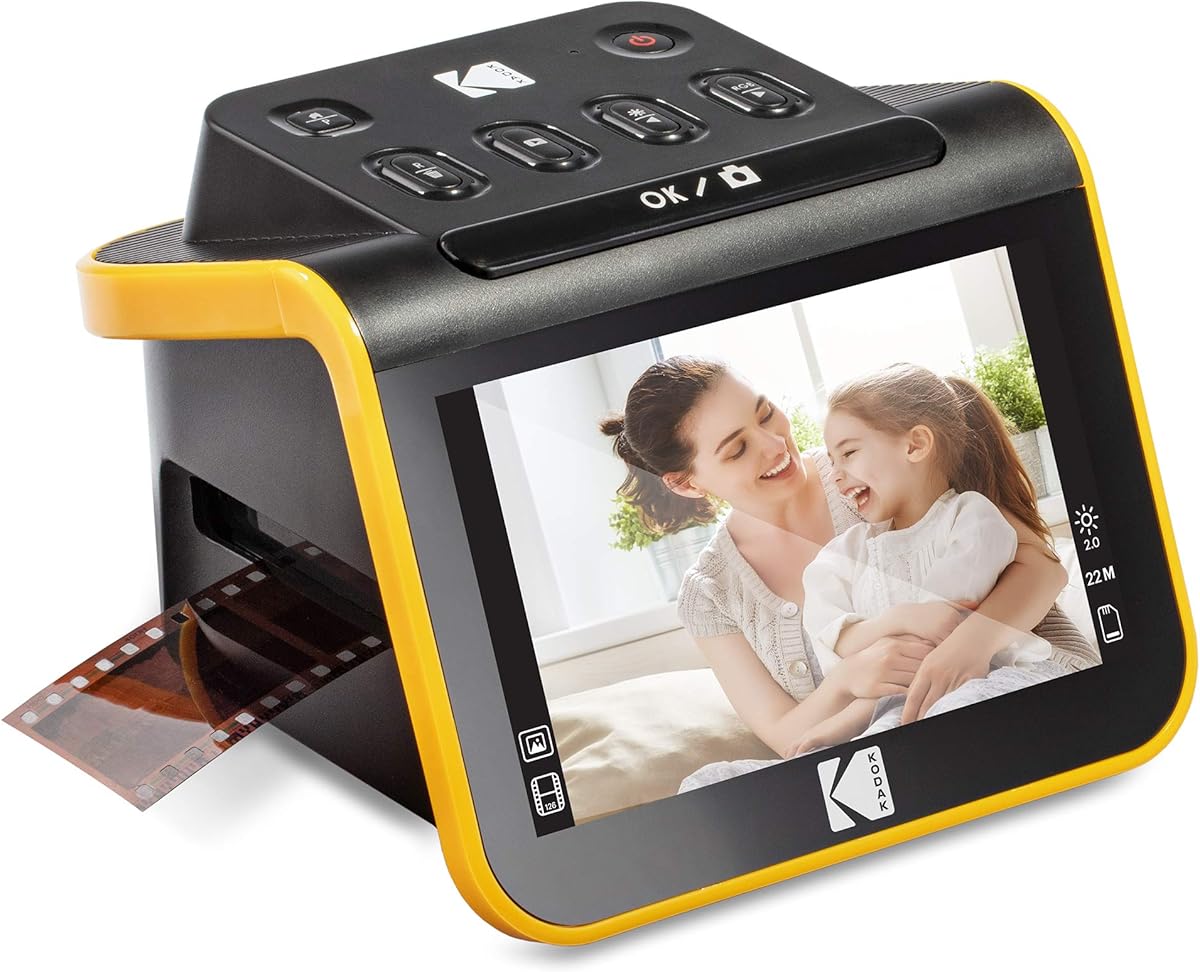
KODAK Slide N Scan Film & Slide Scanner
4.3Editor score
22MP high resolution scanning
5 inch LCD preview screen
Supports multiple film formats
Digitizing old photos preserves memories for future generations. Flatbed scanners designed for film and slides offer superior quality compared to standard models. Choosing the right device ensures your negatives and transparencies are captured with clarity and detail.
We evaluated ten top-rated scanners based on resolution, compatibility, and ease of use. Our analysis covers everything from budget-friendly options to professional-grade tools. Each product was assessed for its ability to handle various film types and deliver accurate color reproduction.
Every selection in this guide highlights specific strengths and ideal use cases. You will find detailed insights into resolution, software, and connectivity. Please note that prices and availability can change frequently, so verify current details before purchasing.
4.3Editor score

4.4Editor score

4.5Editor score
As an Amazon Associate we earn from qualifying purchases.
This side-by-side comparison highlights key specifications across all ten selected models. You will see how each scanner performs in terms of resolution, film support, and additional features like dust removal technology.


The KODAK Slide N Scan is a versatile device designed to digitize old photos and slides efficiently. With a 22MP resolution and a built-in LCD screen, it offers a standalone scanning experience. Its 4.3 rating reflects user satisfaction with its simplicity and effectiveness for home users.
We may earn a commission when you buy through this link, at no additional cost to you.
Key strengths include its convenience and ease of use. The large screen allows you to preview and edit images without needing a computer immediately. It supports various film formats like 135, 110, and 126mm, making it a flexible choice for collectors with mixed media. The ability to save directly to an SD card adds to its portability and workflow efficiency.
Trade-offs exist regarding resolution and advanced editing capabilities compared to professional flatbed scanners. The optical resolution is lower, which may not suit large prints or archival-quality needs. However, for casual sharing and online sharing, these limitations are often acceptable given the lower cost and user-friendly design.
This scanner is ideal for hobbyists or families wanting to digitize memories quickly without technical complexity. It suits those who prioritize ease of use over professional-grade output. For general preservation and sharing, it delivers strong performance at an accessible price point.
The LCD screen and SD card slot allow scanning without a computer connection.
Adapters for various film types ensure flexibility for different collections.
We may earn a commission when you buy through this link, at no additional cost to you.
The Epson Perfection V850 Pro stands out as a top-tier option for serious photographers and archivists. Its 6400 dpi resolution and dual lens system deliver unmatched clarity and detail. With a 4.4 rating, it is praised for its ability to handle both reflective and transparent media with precision.
We may earn a commission when you buy through this link, at no additional cost to you.
This scanner excels in color accuracy and tonal range, thanks to its advanced optics and 4.0 Dmax. The Digital ICE technology effectively removes dust and scratches, saving significant post-processing time. It supports medium format film and various negatives, making it a comprehensive tool for diverse collections. The included software suite enhances its functionality for professional workflows.
The main trade-off is the investment cost and physical size. It requires more desk space and a budget that fits professional needs. However, for users needing archival quality and extensive format support, these factors are justified. The quality of output justifies the higher expense for dedicated users.
Ideal for professional photographers or those digitizing large, valuable collections. It suits users who demand the best possible digital reproduction of their physical media. For high-quality prints or restoration work, this scanner is a reliable and powerful investment.
Two lenses automatically select to optimize resolution for different media types.
Digital ICE tech removes dust and scratches for cleaner digital files.
We may earn a commission when you buy through this link, at no additional cost to you.
The Epson Perfection 4870 PRO is a legendary choice for high-end scanning needs. With 4800 x 9600 dpi resolution and 16-bit grayscale depth, it offers unparalleled detail. Its 4.5 rating highlights its reliability and superior performance for professional-grade digitization projects.
We may earn a commission when you buy through this link, at no additional cost to you.
It features a transparency adapter with four film holders, making it efficient for batch scanning. The included SilverFast software provides advanced control over color and quality. Connectivity via Firewire and USB ensures compatibility with various workstation setups. This scanner is built for users who demand maximum fidelity and control over their scans.
The primary downsides are its cost and older connectivity options compared to modern USB 3.0 models. It may require additional hardware for Firewire support on newer computers. Despite this, its scanning performance remains competitive for those needing specific high-resolution output without compromise.
Best suited for studios or professionals requiring extensive control over image data. It is ideal for archives, fine art reproduction, or critical color correction tasks. For those prioritizing maximum resolution and software flexibility, this model remains a robust choice.
48-bit color depth ensures accurate color reproduction and smooth gradients.
SilverFast Ai software bundle offers advanced tools for color and density control.
We may earn a commission when you buy through this link, at no additional cost to you.
The Epson Perfection V550 is a strong contender for those needing a multi-purpose scanner. It offers 6400 dpi resolution and a built-in transparency unit for scanning slides and negatives. With a 4.2 rating, users appreciate its balance of features and affordability for home office use.
We may earn a commission when you buy through this link, at no additional cost to you.
It stands out for its ReadyScan LED technology, which eliminates warm-up time. Digital ICE removes dust and scratches automatically, enhancing photo restoration efforts. The auto edge detection feature helps in processing multiple photos efficiently. It handles a wide range of media, making it practical for varied needs.
Some users report slower scan times compared to newer models. The build quality may feel less robust than premium options. However, for general digitization tasks and occasional film work, these trade-offs are reasonable. It provides excellent value for its feature set.
Recommended for home users who need to scan documents and photos alike. It is suitable for those starting to digitize family albums without high costs. If balance and ease of use are priorities, this scanner delivers solid performance.
Handles regular documents and film negatives with the same device.
ReadyScan LED allows instant scanning without warming up the lamp.
We may earn a commission when you buy through this link, at no additional cost to you.
The Epson Perfection V600 Photo Scanner is a popular choice for enthusiasts seeking high resolution. With 6400 x 9600 dpi and a built-in Transparency Unit, it handles slides and negatives well. Its 4.0 rating reflects solid performance for digitizing memories and archival work.
We may earn a commission when you buy through this link, at no additional cost to you.
It features ReadyScan LED technology for fast, energy-efficient operation. The included software package supports image enhancement and dust removal. It handles medium-format film and prints up to 8.5 x 11.7 inches. This versatility makes it a flexible tool for various scanning tasks.
Some users find the software interface complex for basic tasks. Speed may vary depending on system specs. However, the scan quality remains consistent. For those seeking a balance between cost and capability, this model is reliable.
Ideal for hobbyists needing high resolution without professional prices. It suits users focusing on family archives or personal collections. If detailed output is needed, this scanner provides the necessary optical capabilities.
Resolution allows large enlargements without significant quality loss.
Includes holders for medium format and 35mm slides and negatives.
We may earn a commission when you buy through this link, at no additional cost to you.
The Epson Perfection V700 Photo Scanner delivers professional quality with its dual lens system. With 6400 dpi resolution and 4.0 Dmax, it ensures exceptional image clarity. Its 4.1 rating shows it is well-regarded for detailed film and photo scanning.
We may earn a commission when you buy through this link, at no additional cost to you.
The dual lens system automatically selects the best lens for the desired resolution. This optimizes both speed and quality for different media types. It handles medium format film and slides effectively. Users appreciate the ability to produce sharp, detailed scans.
It is priced higher than basic models, reflecting its professional capabilities. Setup may take time for new users. However, the results justify the cost for those needing high fidelity. The optical density ensures rich shadows and smooth gradations.
Recommended for users needing higher resolution than standard models. It suits photographers or collectors with medium format needs. If quality and versatility are essential, this scanner is a strong option.
4.0 Dmax captures deep shadow detail better than lower density models.
Handles various film types including medium format with high precision.
We may earn a commission when you buy through this link, at no additional cost to you.
The Epson Expression 12000XL-PH is designed for large format scanning needs. It accommodates reflective media up to 12.2 by 17.2 inches. With 2400 x 4800 dpi, it provides sharp detail. Its 3.9 rating reflects its specific utility for professional or specialized work.
We may earn a commission when you buy through this link, at no additional cost to you.
It features Color II imaging technology for vibrant, bold scans. The transparency unit scans up to 48 frames of 35mm negatives. Easy Photo Fix restores faded colors and removes dust. This makes it ideal for restoring old photos or scanning larger art.
The bulk and weight require a dedicated space. Price is high for casual users. However, for large originals, few flatbeds match its surface area. It ensures consistency across large images.
Best for professionals or users needing large surface area. It suits those with large photos or art to scan. If size matters, this scanner offers a practical solution.
Accommodates original art and documents up to 12.2 by 17.2 inches.
Color II system ensures bold and accurate colors in every scan.
We may earn a commission when you buy through this link, at no additional cost to you.
The Epson Perfection V800 Photo scanner is designed for high resolution scans. With 6400 dpi and 4.0 Dmax, it delivers smooth gradations. Its 4.3 rating highlights its reliability for detailed photo and film digitization.
We may earn a commission when you buy through this link, at no additional cost to you.
It features a Dual Lens System for optimum results on different media. The 16-bit grayscale depth ensures accurate tonal reproduction. It supports various operating systems, offering broad compatibility. Users find it effective for restoring old photos accurately.
Software can feel dated on modern systems, requiring updates. Scanning is not the fastest compared to LED models. However, the quality remains excellent. For detailed archival work, the output is consistent.
Recommended for users needing high detail for small or medium images. It suits archivists prioritizing tonal range. If quality is key, this scanner provides strong results.
4.0 Dmax ensures deep shadows and fine details are captured.
Dual lenses optimize resolution for different film types automatically.
We may earn a commission when you buy through this link, at no additional cost to you.
The Epson Perfection V550 Flatbed Scanner is a capable entry-level model. With 6400 dpi optical resolution and 48-bit color depth, it offers solid performance. Its 3.6 rating indicates good basic functionality for standard scanning tasks.
We may earn a commission when you buy through this link, at no additional cost to you.
It complies with Energy Star standards for efficiency. The USB connection ensures easy setup. It handles basic film and photo scanning. Users find it straightforward for general needs.
It lacks advanced features like Digital ICE compared to other models. Software is minimal, requiring third-party options for editing. However, for raw scans, it is reliable. Its compact design fits small desks.
Best for casual users wanting high resolution without extra features. It suits those needing a simple solution. If basics are enough, this model delivers.
Focuses on scanning basics without complex built-in features.
Energy Star compliance makes it eco-friendly during use.
We may earn a commission when you buy through this link, at no additional cost to you.
The Epson Expression 10000XL is a wide-format scanner designed for graphic arts. With 2400 x 4800 dpi and an A3 surface, it handles larger originals. Its 3.0 rating reflects its niche use for specific professional requirements.
We may earn a commission when you buy through this link, at no additional cost to you.
It offers Firewire and USB 2.0 connectivity for flexible setup. The 3.8 Dmax ensures good density for images. It handles transparency units effectively. Users appreciate the space for large art.
It is outdated compared to newer models and lacks modern features. Price is high relative to current tech. However, for specific wide-format needs, it remains functional. It is best for studios with legacy workflows.
Recommended for professionals needing wide-format capabilities. It suits those with specific large art requirements. If legacy support is needed, this model is viable.
Tailored for professional artists and designers needing larger scanning areas.
Firewire and USB ensure compatibility with older workstation setups.
We may earn a commission when you buy through this link, at no additional cost to you.
Selecting the right scanner involves balancing resolution, film compatibility, and budget. This section breaks down the most critical factors to consider.
Optical resolution determines the level of detail captured from your film. Higher dpi allows for larger prints and better zooming capabilities. Aim for 6400 dpi for high-quality film scanning.
Prioritize optical resolution over interpolated values for best results.
A built-in transparency unit is essential for scanning slides and negatives. It holds film securely while light passes through for capture. Without it, you cannot scan transparent media.
Ensure the scanner includes a dedicated film holder for easy loading.
Check which film formats the scanner supports, such as 35mm or medium format. Some models offer adapters for multiple types like 110 or 126mm. Versatility is key if you have diverse collections.
Verify adapter availability before purchasing to avoid compatibility issues.
Digital ICE or similar technologies remove dust and scratches automatically. This saves significant time during post-processing. Look for scanners that explicitly mention this feature.
This feature is crucial for older films prone to damage.
Color depth like 48-bit ensures accurate color reproduction. Optical density (Dmax) affects shadow detail capture. Higher values preserve more information in dark areas.
Aim for high bit depth for professional archival needs.
Software bundled with the scanner aids in editing and organizing. Look for tools for restoration, cropping, and file management. Some brands offer professional software like SilverFast.
Strong software can simplify your digitization workflow.
Modern USB 2.0 or 3.0 connections ensure fast data transfer. Some high-end models may still support Firewire. Compatibility with your operating system is also key.
Choose a scanner with modern ports to match your computer.
Prices range from under 200 for basic models to thousands for pro ones. Assess how often you scan to decide the best investment. High-end models pay off for frequent, high-quality work.
Balance features with your expected usage frequency for best value.
Before scanning, clean your film and scanner glass to avoid dust artifacts. Use a soft brush or air blower to remove debris. Proper cleaning ensures sharp scans.
Position the film correctly in the holder to prevent damage. Avoid touching the emulsion side of slides or negatives. Always use the provided holders for best results.
Store your scanner in a cool, dry place when not in use. Dust covers help keep the glass clean. Regular maintenance extends the lifespan of the device.
Optical resolution is the physical limit of the scanner hardware. Interpolated resolution is software-enhanced. Rely on optical resolution for true detail.
Most scanners connect via USB and work with standard PCs or Macs. Check OS compatibility on the product page. Some legacy models may lack drivers for modern systems.
Many professional models like the V600 or V850 support medium format. Always check the specific model's dimensions. Basic models may be limited to 35mm.
Adobe Photoshop offers extensive tools. Some scanners include restoration software like Photo Fix. Specialized tools like SilverFast are excellent for color correction.
Digital ICE technology handles this automatically. If not available, use editing software. Always clean the film before scanning.
TIFF preserves quality for editing. JPEG is smaller for sharing. Choose based on your storage and usage needs.
Portable scanners exist but often lack resolution. They suit quick digitization needs. For best quality, use flatbeds.
Blur can come from dirty glass or low resolution. Clean all surfaces. Check that the film is flat. Ensure you are using optical resolution.
We explored ten top scanners offering different levels of quality and convenience. The Kodak Slide N Scan leads in budget and ease, while Epson models offer professional power.
Prioritize features like resolution and transparency units based on your collection type. If quality is paramount, invest in models with Dual Lens or Digital ICE technology.
Remember to verify current prices and availability before buying. Technology evolves, so check the latest updates for the best deal.