
Hunter Rain-Clik WRCLIK
4.6Editor score
Wireless maintenance-free design
Instant rain and freeze shutoff
Easy gutter or wall mounting
This guide compares the top irrigation controllers with rain sensors to help you save water and protect your lawn from overwatering and freeze damage this
Managing water usage for your landscape requires smart technology that adapts to changing weather conditions. Irrigation controllers with rain sensors provide automated shut-off capabilities that prevent unnecessary watering during storms or freezing temperatures. These devices help homeowners maintain healthy lawns while reducing utility bills and conserving precious resources.
We evaluated ten leading products based on their sensor accuracy, installation ease, and compatibility with existing sprinkler systems. Our analysis focuses on wireless options, wired controllers, and smart WiFi-enabled models that offer remote access and weather-based scheduling. Each product was selected for its ability to integrate seamlessly into residential and light commercial irrigation setups.
Each pick below highlights specific strengths such as budget-friendly pricing, advanced smart features, or rugged outdoor durability. Remember that product availability and pricing can fluctuate rapidly due to market demand and seasonal promotions. Always verify the current specifications and terms before making your final purchase decision online.
4.6Editor score

4.5Editor score
4.5Editor score
The following table provides a side-by-side comparison of all ten products evaluated in this guide. It highlights key specifications and primary features to help you quickly identify which model fits your specific irrigation needs and budget constraints.



The Hunter Rain-Clik WRCLIK stands out as a top choice for homeowners seeking an affordable and effective way to stop unnecessary watering during rain or freeze events. With a high rating from users, this wireless sensor delivers reliable performance without the need for complex wiring or professional installation. Its simple design ensures that it works seamlessly with most standard sprinkler controllers found in residential settings.
We may earn a commission when you buy through this link, at no additional cost to you.
This device utilizes Quick Response technology to immediately halt your sprinkler system the moment rain begins or temperatures drop to 37 degrees Fahrenheit. This feature is crucial for preventing water waste and protecting delicate plants from freeze damage. The built-in battery means you can install it in minutes on a gutter or wall without trenching or hiring an electrician.
While the unit is highly efficient, users should note that it requires periodic battery checks to ensure continuous operation. Additionally, this product functions as a sensor only, meaning it must be paired with an existing irrigation controller to manage your watering schedule. These trade-offs are acceptable given the low cost and ease of integration it offers.
If you already have a functioning irrigation controller but want to add smart weather responsiveness without a major upgrade, this sensor is an ideal solution. It is particularly well-suited for busy homeowners who need a set-and-forget device that protects their lawn from overwatering and cold snaps automatically.
The wireless design allows for flexible placement on gutters or walls without special tools or professional help.
Works with most standard sprinkler controllers using normally open or normally closed sensor ports for broad utility.
We may earn a commission when you buy through this link, at no additional cost to you.
The Rain Bird TRU6I offers a robust balance of functionality and ease of use, making it a favorite for homeowners who want precise control over their irrigation zones. Rated highly by users, this controller supports up to six zones and allows for specialized watering schedules that cater to different areas of your yard. It serves as an excellent foundation for smart irrigation when paired with the optional WiFi module.
We may earn a commission when you buy through this link, at no additional cost to you.
Key strengths include its flexible program-based settings that let you create distinct start times for each zone, ensuring optimal hydration without overlap. The intuitive programming dial and multi-function LCD display make setup straightforward even for those new to irrigation technology. Features like Season Adjust and Rain Delay provide additional layers of control to adapt to changing weather patterns.
One limitation is that the WiFi capability requires purchasing the LNK2 module separately, which adds to the initial cost. Additionally, the unit is designed for indoor installation, so you may need a weatherproof enclosure if placing it in a garage or shed subject to extreme temperatures. These minor drawbacks do not significantly diminish its overall value for the price.
We recommend this controller for homeowners who want a reliable, expandable system that can grow with their landscaping needs. It is a strong pick for those who value detailed scheduling options and plan to upgrade to smart features later without replacing the main unit.
Individual programs per zone with multiple start times allow for highly customized watering routines.
Permanently stores programming during power outages to prevent the need for re-entry after blackouts.
We may earn a commission when you buy through this link, at no additional cost to you.
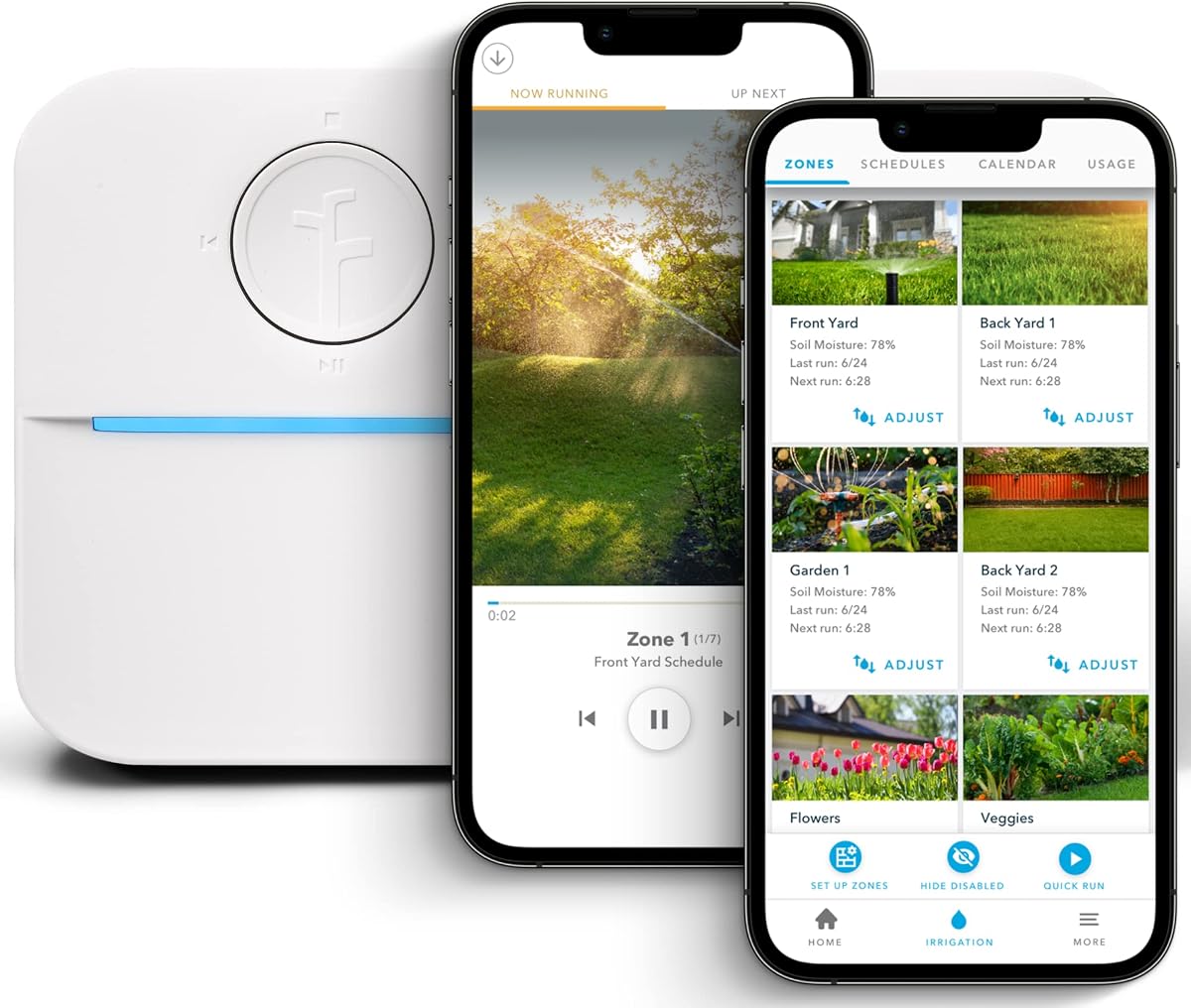
The Rachio 3 Smart Sprinkler represents the pinnacle of smart irrigation technology, offering unparalleled convenience and water savings through its advanced weather intelligence. With a strong user rating, this controller eliminates the need for manual adjustments by automatically skipping watering cycles when rain, wind, or freeze is predicted. Its free app provides precise control from anywhere, making it a top choice for tech-savvy homeowners.
We may earn a commission when you buy through this link, at no additional cost to you.
Standout features include Adaptive schedules that help your yard thrive in varying weather conditions and grow-in options for new plantings. The fast DIY install process ensures that you can have your system up and running in thirty minutes or less. Integration with Amazon Alexa and Google Assistant adds voice control capabilities that further enhance user experience.
The premium price point is a consideration for budget-conscious buyers, and the system relies on a stable WiFi connection to function optimally. In areas with poor connectivity, you may experience delays or failures in receiving weather updates. However, the water savings and time convenience often justify the investment over the lifespan of the device.
For those seeking a fully automated solution that minimizes manual intervention and maximizes efficiency, this controller is an exceptional investment. It is particularly beneficial for users with complex landscapes or those who travel frequently and need to manage their yard remotely.
Patented Weather Intelligence automatically skips watering based on local forecasts to prevent overwatering and waste.
Manage watering, run zones, and track estimated usage with an intuitive mobile application interface.
We may earn a commission when you buy through this link, at no additional cost to you.
The Rain Bird ESP-TM2 is designed for versatility, offering a robust eight-zone capacity that suits larger residential properties while remaining easy to program. Users appreciate its factory-installed outdoor-rated power cord, which simplifies installation significantly compared to models requiring hardwiring. This controller is built to withstand various environmental conditions, making it a reliable choice for both indoor and outdoor mounting locations.
We may earn a commission when you buy through this link, at no additional cost to you.
Its advanced features include a contractor default setting that allows for easy restoration of custom schedules, which is helpful for maintenance professionals. The large back-lit LCD display ensures visibility in direct sunlight or low-light environments, improving usability for all ages. Internet-based weather information helps adjust daily schedules to save up to thirty percent in water costs.
While the WiFi functionality is a strong selling point, it requires the purchase of a separate LNK WiFi module to activate. Additionally, the controller is not waterproof without proper enclosure, so outdoor placement needs protection from direct rain. These considerations are standard for this class of device and do not detract from its overall performance.
This model is recommended for homeowners who want a durable, high-capacity controller that can be easily managed via app when paired with the module. It offers a great balance of professional features and user-friendly design for those seeking long-term reliability.
The factory-installed power cord is rated for outdoor use to reduce the need for external power adapters.
Automatically adjusts irrigation schedules based on internet weather data to optimize water usage effectively.
We may earn a commission when you buy through this link, at no additional cost to you.
The Rain Bird ESP4ME3 is an expandable controller that starts with four zones but can grow to support up to twenty-two with optional modules. This scalability makes it ideal for properties that may add more irrigation zones in the future. It supports optional wired flow sensors for monitoring water usage and detecting leaks to protect your property from water damage.
We may earn a commission when you buy through this link, at no additional cost to you.
Features like non-volatile memory ensure that your settings are saved indefinitely even during long power outages. The controller includes a power cord for quick plug-in indoor or outdoor installations, reducing the need for hardwiring. When paired with the LNK WiFi module, you can access, operate, and monitor your system from anywhere using your phone.
One drawback is that the base unit only supports four zones, which may not be enough for large properties without expansion. Additionally, smart features depend on the separate purchase of the WiFi module which adds to the total cost. However, the ability to expand without replacing the controller offsets these initial limitations.
We suggest this controller for homeowners planning long-term irrigation expansion or those who need leak detection capabilities. It is a solid investment for managing complex landscapes where reliability and future-proofing are priorities.
Optional modules allow you to expand from four to twenty-two stations without removing the existing controller.
Compatible flow sensors help monitor usage and alert you to potential leaks to save water.
We may earn a commission when you buy through this link, at no additional cost to you.
The Rain Bird ESPME3 offers significant flexibility with station count options ranging from four to twenty-two, making it suitable for residential and light commercial sites. Users can add station modules to expand the system without powering down the controller. This feature ensures that landscaping projects can be completed with minimal disruption to ongoing irrigation schedules.
We may earn a commission when you buy through this link, at no additional cost to you.
Key features include a large 3-inch back-lit screen and color-coded dial positions that make programming easy even in dark garages. The controller provides system alerts via a red LED and scrolling messages to notify you of electrical or flow issues when paired with a flow sensor. It comes with a power plug and outdoor cabinet for secure installation.
While the controller is powerful, smart features require the addition of the LNK WiFi module and WR2 rain sensor. Without these upgrades, you will need to manually update schedules and cannot access the system remotely. The initial cost is reasonable but the total system cost increases with necessary accessories for full functionality.
This controller is recommended for larger properties or light commercial applications that require expandability and robust system alerts. It is a practical choice for those who prioritize control and reliability over immediate smart features.
Red LED and scrolling messages coupled with mobile alerts inform you of system issues quickly.
Add station modules when expanding irrigation without removing or powering down the controller.
We may earn a commission when you buy through this link, at no additional cost to you.
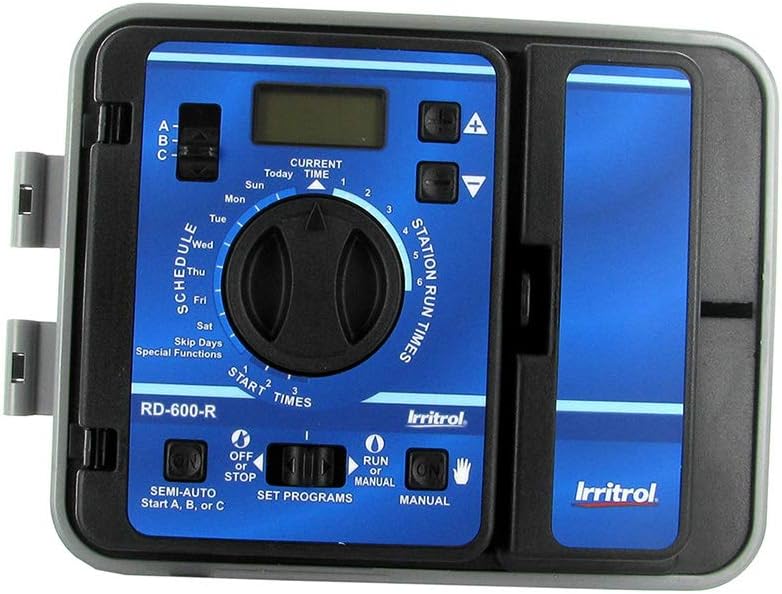
The Irritrol RD600-EXT-R provides a classic outdoor irrigation controller experience with a focus on durability and functional simplicity. It features three independent programs that offer the flexibility to meet the needs of different plant materials on your landscape. This design allows for customized watering routines that optimize plant health without manual interference.
We may earn a commission when you buy through this link, at no additional cost to you.
Key benefits include remote control compatibility with the Contractor Residential Remote series for easy adjustments. The unit includes a rain sensor bypass switch and terminal for sensor hookup, allowing you to integrate rain sensors easily. Water well recovery options let you manage pump cycles efficiently, reducing strain on your water system.
Lack of built-in smart features means you must rely on manual programming or external smart upgrades. For tech-focused users, this might be a limitation compared to WiFi-enabled alternatives. However, for those who prefer a straightforward system with reliable hardware, this model remains a trusted option.
This controller is ideal for homeowners who want a robust outdoor unit that works with existing sensors and remotes. It is a great choice for those who do not need mobile app control but value solid build quality and program flexibility.
Three independent programs meet the needs of a wide variety of plant material on the landscape site.
Compatible with contractor residential remote series for easy control without manual interaction.
We may earn a commission when you buy through this link, at no additional cost to you.
The Rain Bird TM2-6 is a straightforward controller designed for homeowners with standard irrigation needs requiring up to six zones. It features a familiar and easy to navigate user interface that minimizes the learning curve for new users. The unit supports rain sensor input with bypass capability, allowing you to adapt to weather conditions without full automation.
We may earn a commission when you buy through this link, at no additional cost to you.
Important features include a master valve/pump start circuit that supports larger irrigation setups. Its indoor/outdoor compatibility means you can install it in various locations depending on your home layout. The simple design ensures reliable operation without complex menus or unnecessary technical requirements.
While efficient, this model lacks advanced smart capabilities and extensive program options found in newer controllers. Users looking for weather-based scheduling or mobile control will need to look at more feature-rich models. However, for basic schedule control and rain sensor integration, it offers good value.
We recommend this controller for those with simpler yards who want a reliable, no-fuss solution. It is a solid pick for budget-conscious buyers who prioritize essential functionality over smart features.
Familiar easy to navigate user interface allows for quick programming without complex steps.
Rain sensor input with bypass capability lets you manually override or integrate sensor data easily.
We may earn a commission when you buy through this link, at no additional cost to you.
The Orbit Rain and Freeze Sensor provides a simple and effective way to prevent overwatering during storms or freezing temperatures. It uses water-absorbing disks that expand when wet to signal the controller to suspend watering. A built-in thermistor also detects low temperatures to protect your system from freeze damage.
We may earn a commission when you buy through this link, at no additional cost to you.
Key features include weather-resistant wire runs that connect the controller to an open area like an eave. The threshold for triggering a rain delay is adjustable so you can tune sensitivity to your specific climate. It is compatible with controllers from Orbit, Hydro-Rain, and other major brands for broad application.
Unlike wireless options, this sensor requires wiring which may be challenging for those wanting quick installation. Also, the mechanical disks may require replacement over time due to wear from UV exposure. However, its low cost and reliable performance make it a practical choice for basic weather protection.
This sensor is recommended for homeowners on a budget who need a reliable way to stop irrigation during rain. It is a great accessory for existing controllers that lack built-in weather detection features.
Automatically detects rainfall or low temperature conditions to suspend watering and save water.
Adjustable threshold allows you to change the sensitivity for triggering a rain delay as needed.
We may earn a commission when you buy through this link, at no additional cost to you.
The Rain Bird ARC8 puts control of your sprinkler system in the palm of your hand with an intuitive mobile app. It is EPA WaterSense Certified which means it meets strict criteria for water efficiency and performance. The unit can be operated via your mobile device anywhere in the world allowing you to set, monitor, or adjust schedules remotely.
We may earn a commission when you buy through this link, at no additional cost to you.
Key strengths include the ability to automatically skip or adjust daily watering based on local weather forecasts to save up to 30% in water. You can share control with family members or landscaping professionals easily which enhances collaboration. It is compatible with Amazon Alexa and Google Assistant for voice control convenience.
Some users report connectivity issues or app reliability problems which can hinder full functionality. Also, the system depends on a strong internet connection to receive weather data and send commands. Despite these concerns, the potential for water savings and convenience make it a compelling option for smart homes.
We suggest this controller for those who prioritize mobile access and water conservation certifications. It is a strong choice for users comfortable with smart home ecosystems who can manage occasional connectivity adjustments.
EPA WaterSense certified to meet strict criteria for water efficiency and performance standards.
Compatible with Amazon Alexa and Google Assistant for voice control convenience and access.
We may earn a commission when you buy through this link, at no additional cost to you.
Selecting the right irrigation controller and rain sensor involves evaluating several critical factors to ensure optimal performance and water conservation.
Modern rain sensors use advanced technologies like wireless disk mechanisms or electronic conductivity to detect precipitation. Wireless models offer easier installation but may require battery changes while wired sensors provide reliable continuous operation without power needs. Choose a type that aligns with your willingness to perform maintenance and your existing wiring setup.
Evaluate the technology to ensure it matches your installation preferences and maintenance tolerance.
Ensure the rain sensor is compatible with your current irrigation controller. Most modern systems support standard normally open or normally closed sensor ports but older models may require adapters. Check the manufacturers documentation to confirm compatibility before purchasing to avoid installation issues.
Confirm compatibility with your existing controller to prevent integration issues.
Installation complexity varies by model with wireless sensors offering the easiest setup requiring no wiring. Wired systems may need trenching or professional help which adds to the total cost. Consider your DIY skills and time availability when selecting a unit to ensure you can complete the installation successfully.
Choose a unit that matches your DIY skills to avoid professional costs.
Zone capacity refers to the number of sprinkler zones the controller can manage independently. Homeowners should select a controller that supports at least as many zones as they currently have plus extra for future expansion. Undersized controllers can lead to inefficient watering schedules and limit landscaping growth options.
Select a controller with enough zones to cover your current and future needs.
Smart controllers offer WiFi connectivity and mobile app control to manage irrigation remotely. Features like weather-based scheduling can automatically adjust watering times to save money and reduce utility costs. However these features often require additional modules or subscriptions which increase the overall price.
Prioritize smart features that provide genuine convenience for your lifestyle.
Since these devices are often mounted outdoors they must withstand exposure to sun rain and temperature fluctuations. Look for units with weather-resistant enclosures and high IP ratings to ensure longevity. A durable controller will reduce the need for frequent replacements and maintain consistent performance over years.
Look for weather-resistant enclosures to ensure long-lasting performance outdoors.
Price varies significantly from basic sensors to advanced smart controllers. While higher priced models offer more features basic units often perform the core task of stopping water during rain effectively. Assess your budget against the features you need to find the best value proposition.
Compare price against features to find the best value for your needs.
Intuitive interfaces with clear LCDs and simple dials make programming easier for all users. Complex menus can lead to errors in scheduling which wastes water and affects plant health. Test or research the user interface to ensure it is straightforward before purchase to avoid frustration.
Ensure the interface is intuitive to avoid scheduling errors.
When installing your rain sensor place it in an open area where it can directly receive rainfall without obstruction from roofs or trees. Ensure the wires or wireless link are secure to prevent accidental disconnection during storms or maintenance.
Regularly inspect the sensor disks or probes for dirt debris or discoloration that may affect performance. Clean them gently with water and a soft cloth to maintain accurate detection. Replace worn parts promptly to keep the system reliable.
Update your controller software and check for new firmware releases to maintain optimal performance and security. Adjust watering schedules seasonally to reflect changing weather patterns and plant needs. This proactive care will extend the life of your system and keep your lawn healthy.
If your controller uses weather data from the internet to adjust schedules it may not need a physical sensor. However a physical sensor provides an extra layer of protection against sudden heavy rains that forecasts might miss. Using both ensures maximum water savings and protection for your lawn.
Check your controller manual for mentions of sensor inputs such as normally open or normally closed ports. Most modern controllers support standard rain sensors but older models may lack this feature. If unsure contact the manufacturer support team to confirm compatibility.
Wired sensors connect directly to the controller via cables which can be tedious to install but require no batteries. Wireless sensors use battery power and a signal to communicate making installation easier but requiring periodic battery checks. Choose based on your installation constraints and maintenance preferences.
Battery life varies by model but typically ranges from one to three years depending on usage and climate. Always check the manual for specific recommendations and keep spare batteries on hand. Replacing batteries annually is a good practice to ensure consistent performance.
Many wireless sensors are designed for DIY installation with simple mounting brackets and minimal tools. However wired models may require trenching or electrical knowledge which might require a professional. Assess your comfort level with the installation before proceeding.
If a sensor gets stuck in the wet position it may cause your sprinklers to never turn on. Check for debris or dirt blocking the mechanism and clean it carefully. Adjust the sensitivity threshold if possible to prevent false triggers from minor moisture.
Some regions mandate rain sensors to conserve water during drought conditions while others do not. Check your local municipality regulations to see if compliance is required for new installations. Adhering to local rules can avoid fines and support environmental conservation efforts.
Most sensors reset automatically once they dry out but some require manual activation via a button or dial. Refer to your product manual for specific reset instructions to avoid confusion. Ensuring the device is dry will usually restore normal watering schedules quickly.
Our top picks highlight diverse options from the budget-friendly Hunter Rain-Clik WRCLIK to the advanced Rachio 3 Smart Sprinkler. Each model offers unique strengths depending on your needs for smart features simplicity or expandability.
Prioritize compatibility with your existing setup and consider how much maintenance you are willing to perform. A simple sensor might suffice for basic needs while smart controllers offer greater convenience and savings.
Always verify current pricing and availability before purchasing as market conditions can change quickly. Investing in the right system today will help you save water and maintain a healthier lawn for years.