
SUNLU Filament Dryer Box S1 Plus
4.3Editor score
Fast drying with fan design
Visual LCD display screen
Personalized temperature settings
Compare the top 10 Filament Dryer Box options for 3D printing moisture control, storage, and print quality improvement in October 2026.
Moisture absorption is a silent killer of 3D printing quality. Filament Dryer Box units solve this by actively drying and storing spools in sealed environments. They prevent stringing, bubbling, and weak layer adhesion common with damp materials like nylon or PETG.
We evaluated ten leading models based on heating speed, capacity, sealing quality, and user interface. Our analysis covers everything from budget-friendly single spool dryers to advanced dual-chamber systems designed for high-volume workflows and engineering-grade polymers.
Each pick highlights specific strengths, ideal use cases, and technical limitations. While prices fluctuate on Amazon, our focus remains on value, durability, and performance consistency. Always check current offers before purchasing to ensure you get the best deal available today.
4.3Editor score

4.6Editor score

4.6Editor score
This side-by-side comparison contrasts the key specifications of the top ten filament dryer boxes currently available. We examine heating technology, spool capacity, temperature ranges, and sealing mechanisms to help you find the perfect match for your 3D printing needs.


The SUNLU Filament Dryer Box S1 Plus offers an accessible entry point for printers struggling with moisture issues. With a solid rating and intuitive controls, it provides reliable drying for common materials without breaking the bank.
We may earn a commission when you buy through this link, at no additional cost to you.
Its standout feature is the fan-assisted drying system which accelerates moisture removal compared to passive heating. The visual display clearly shows temperature and humidity, allowing precise adjustments. The temperature range suits most standard filaments like PLA and PETG perfectly.
While effective for general use, the maximum temperature of 55 degrees Celsius limits its use for high-performance engineering plastics. It also holds only one spool, which might be restrictive for users managing multiple projects simultaneously.
This unit is ideal for hobbyists or small setups needing a simple, effective solution. It balances cost and performance well, making it a strong recommendation for those prioritizing budget over advanced engineering capabilities.
The integrated fan design actively circulates air to speed up water evaporation from filament coils significantly.
Users can monitor real-time temperature and humidity readings on a dedicated LCD screen for better process control.
We may earn a commission when you buy through this link, at no additional cost to you.
The Creality Space Pi X4 Filament Dryer stands out as a premium solution for high-volume printing needs. Its ability to dry four spools simultaneously with independent heating chambers makes it a top choice for serious users.
We may earn a commission when you buy through this link, at no additional cost to you.
The dual independent 200W heating chambers allow different filament types to be dried at optimal temperatures without compromise. The industry-first touch UI offers precise control and easy monitoring via an illuminated window. It effectively prevents moisture re-absorption during pauses.
While the cost is higher, the investment pays off in reduced waste and increased efficiency. The larger size requires ample workspace, which may be a constraint for smaller desks. However, the performance justifies the space usage.
This dryer is perfect for professionals or enthusiasts with multiple printers. It offers the versatility and speed needed for complex workflows, ensuring consistent print quality across a wide range of material types.
Two separate heating zones enable simultaneous drying of different materials at their specific required temperatures.
A sophisticated touch screen interface allows for precise adjustments and easy navigation through drying presets.
We may earn a commission when you buy through this link, at no additional cost to you.
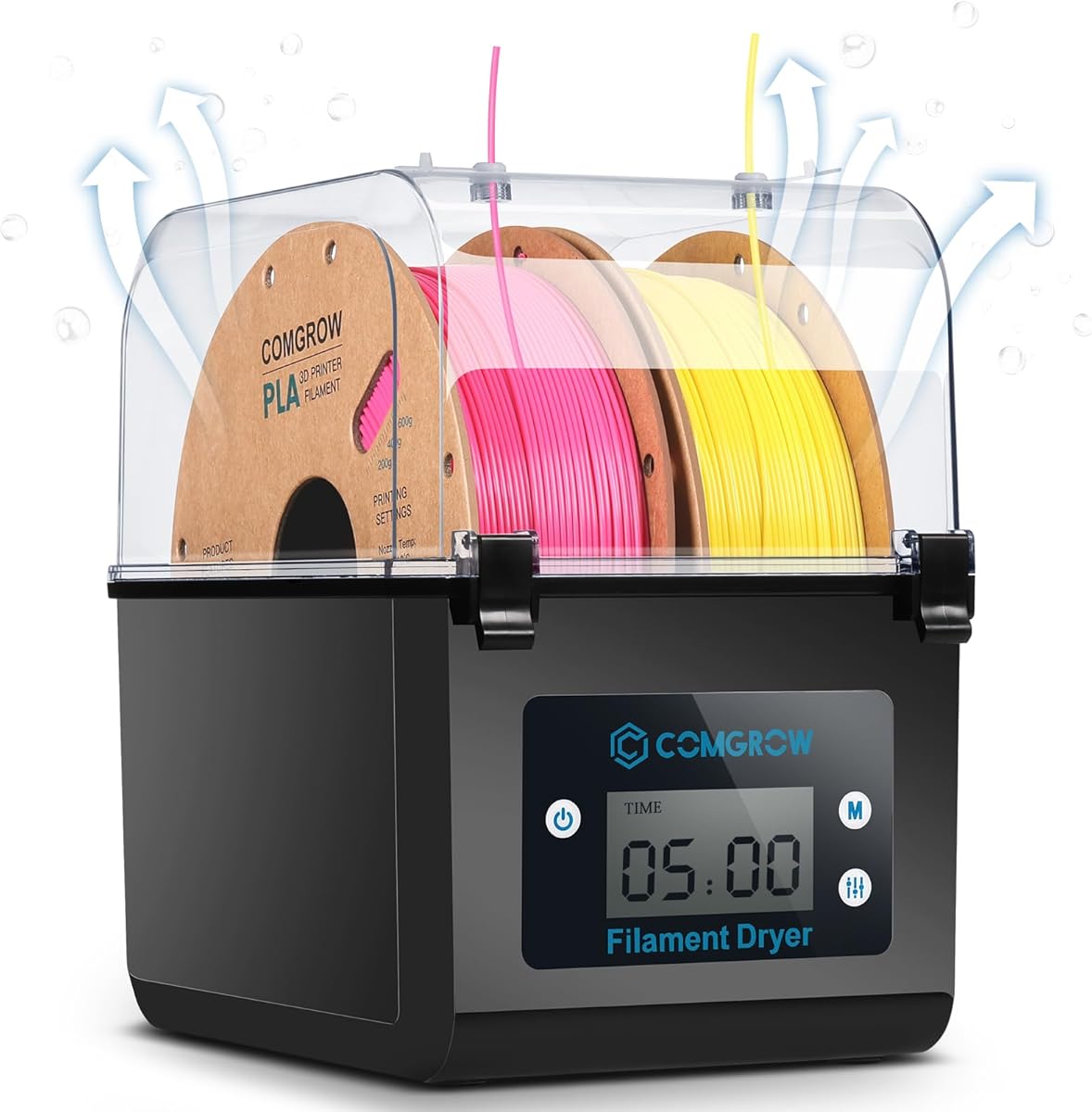
Comgrow SH01 Filament Dryer Box provides a practical solution for users needing moderate capacity drying. Its 2 spool capacity and clear LCD screen make it accessible for home labs without sacrificing essential drying features.
We may earn a commission when you buy through this link, at no additional cost to you.
The unit features a large storage volume and a sealed design that keeps filaments dry during printing. Real-time monitoring of temperature and humidity ensures you stay within safe operational ranges. The silicone sheath outlet protects cables effectively.
The maximum temperature of 50 degrees limits its use for high-temperature engineering filaments. The initial setup can be slightly complex due to motherboard checks. However, once configured, it operates reliably with minimal intervention.
Best suited for users who need to dry multiple standard spools simultaneously. It offers a balance between capacity and cost, making it a dependable addition for those who print frequently with standard materials.
Storing two spools inside allows for continuous printing without needing to swap or dry materials between jobs.
The silicone cable sheath and Teflon tube ensure the enclosure remains sealed to prevent moisture intrusion.
We may earn a commission when you buy through this link, at no additional cost to you.
The Polymaker Polydryer Storage Box is designed for long-term storage rather than active drying. It creates a moisture-free environment using an airtight seal and desiccant support, ideal for preventing re-absorption during pauses.
We may earn a commission when you buy through this link, at no additional cost to you.
Its built-in hygrometer allows users to track humidity levels without opening the box. The design ensures filament remains dry between uses, reducing the risk of print quality degradation. It supports a wide range of filament types seamlessly.
Without active heating, it relies solely on physical sealing to keep moisture out. Users must manage desiccant packs manually to maintain effectiveness. This limits its utility for reviving already damp filaments quickly.
This box is perfect for those needing reliable storage rather than active drying. It is a cost-effective way to protect filament investments over time, especially for users in humid climates.
The visible humidity reading helps monitor storage conditions easily without guesswork or external tools.
Printers can feed filament without breaking the seal, ensuring continuous moisture protection during long prints.
We may earn a commission when you buy through this link, at no additional cost to you.
SUNLU Filament Dryer S2 combines large storage capacity with active drying capabilities. Its high capacity allows for holding multiple spools, making it suitable for users with high-volume printing requirements.
We may earn a commission when you buy through this link, at no additional cost to you.
The built-in spindle ensures continuous filament rotation for even drying and temperature distribution. Users can check the filament through the translucent lid without interrupting the process. The temperature range supports a broad variety of materials.
The large physical size might not fit all workspaces. It consumes more energy than smaller units due to its larger volume. However, the trade-off provides greater versatility for diverse printing needs.
Ideal for busy workshops needing a single unit to handle various materials. The design focuses on efficiency and ease of use, ensuring filament remains in optimal condition for every print job.
Continuous rotation ensures every part of the spool is exposed to heat for uniform moisture removal.
The translucent lid allows users to monitor drying progress without opening the unit and breaking the seal.
We may earn a commission when you buy through this link, at no additional cost to you.
The Comgrow SH02 Filament Dryer Box offers fast and efficient drying with its advanced PTC heater. It heats up quickly to 50 degrees within minutes, ensuring minimal wait time for users starting a print job.
We may earn a commission when you buy through this link, at no additional cost to you.
The 360 degree hot air circulation ensures uniform heating throughout the chamber, preventing cold spots that could leave moisture trapped. Intelligent safety protection automatically cuts off heating if temperatures exceed limits, enhancing durability.
While effective, the unit requires fan maintenance to avoid alarms. The max temperature of 70 degrees suits most materials but may struggle with very high-performance engineering resins. Still, it is a robust choice for general use.
This dryer is excellent for users needing speed and reliability. The preset options simplify setup, making it easy to get started quickly with different filament types without manual calibration.
A built-in fan ensures hot air circulates evenly for consistent drying across all loaded spools.
Automatic heating cutoff and fan alarms protect the unit from overheating or mechanical failures.
We may earn a commission when you buy through this link, at no additional cost to you.
Creality Space PI Filament Dryer uses advanced PTC heating technology for uniform drying results. The 3.7-inch touch screen makes operation straightforward and allows for precise tracking of drying conditions.
We may earn a commission when you buy through this link, at no additional cost to you.
It supports up to 12 types of filaments with one-key settings, simplifying the workflow for diverse projects. The 48-hour timer ensures long prints can be managed without constant monitoring. The memory function retains settings after power loss.
The single spool capacity limits throughput for large-scale operations. While the heating is uniform, it may take longer than dual-chamber models for fully dried results. Still, it offers excellent control.
This unit is best for users valuing precise control and ease of use. It bridges the gap between affordability and advanced features, making it a versatile choice for home and small business studios.
Support for 12 filament presets covers everything from PLA to composite materials with minimal configuration.
Settings are retained after power outages, allowing the dryer to resume operation without manual reset.
We may earn a commission when you buy through this link, at no additional cost to you.
The Creality Space PI Dryer Plus builds on the standard model with dual spool support and real-time humidity monitoring. It maintains the efficient PTC heating technology for consistent drying results across two filament spools.
We may earn a commission when you buy through this link, at no additional cost to you.
Users benefit from seeing humidity levels directly on the screen to ensure dryness. The unit supports adjustable temperatures and memory functions for convenience. It is designed to integrate smoothly into existing printing workflows.
While the capacity is improved over single spool models, it still falls short of larger 4-spool systems. The focus remains on efficient, single-task drying rather than extensive automation features.
This dryer is ideal for small teams needing flexibility without the bulk of high-end units. It offers reliable performance and visibility into environmental conditions, ensuring quality output for most common materials.
Real-time humidity data allows users to adjust drying cycles proactively based on moisture levels.
Loading two spools increases throughput significantly compared to single-spool dryers for busy users.
We may earn a commission when you buy through this link, at no additional cost to you.
Creality Space Pi X4L offers high-volume storage with four spool capacity and dual independent heating chambers. It maintains the robust design of the X4 series while optimizing for consistent performance across all chambers.
We may earn a commission when you buy through this link, at no additional cost to you.
The silicone-sealed enclosure prevents moisture re-absorption effectively. Independent chambers allow drying different filaments at different temperatures, increasing versatility. It supports engineering materials with a max temperature of 75 degrees.
The large size demands significant workspace and power. It may be overkill for casual users but is essential for industrial setups. The price reflects its capacity and advanced thermal management features.
This unit is best for professional environments needing continuous operation. It ensures multiple materials are ready simultaneously, reducing downtime and improving overall printing efficiency for complex projects.
Dual chambers allow simultaneous drying of different materials at optimized settings for each type.
Silicone sealing ensures humidity stays out even during long pauses, maintaining filament integrity.
We may earn a commission when you buy through this link, at no additional cost to you.
The Official Creality Space Pi X4 DB-05 represents the pinnacle of filament drying technology. It features independent temperature control for two chambers and high-efficiency 200W heaters capable of reaching 85 degrees for advanced polymers.
We may earn a commission when you buy through this link, at no additional cost to you.
It supports energy-saving modes that reduce power consumption when drying only one chamber. The dual heating setup allows simultaneous preparation of multiple materials at optimal settings. This efficiency is unmatched in its class.
The high cost and complexity might deter casual users. The interface requires familiarity to leverage all features fully. However, for professional users, the performance justifies the investment in precision engineering.
This dryer is perfect for industrial or high-end home labs. It ensures engineering filaments are dried correctly every time, maximizing print quality and minimizing material waste through precise thermal management.
With 85 degrees capability, it handles high-performance polymers like PC and PAHT reliably.
Flexible modes allow single-chamber usage to save up to 40 percent energy during lighter workloads.
We may earn a commission when you buy through this link, at no additional cost to you.
Selecting the right Filament Dryer Box depends on your specific printing volume and material needs. We break down the essential factors to consider for making an informed decision.
Determine how many spools you need to dry simultaneously. Single spool models are compact but require frequent swaps. Dual or quad spool models increase workflow efficiency for multi-printer setups.
Choose a capacity that matches your daily or weekly print load to avoid bottlenecks in material preparation.
Different filaments require different drying temperatures. PLA and PETG generally need lower heat around 50 degrees. Engineering materials like ABS, PA, or PC require higher temps up to 75 or 85 degrees.
Ensure the unit supports the maximum temperature needed for your most demanding materials to avoid under-drying.
PTC heaters are generally more efficient and safer than traditional heating pads. They provide consistent heat without overheating risks. Check for 360-degree air circulation for uniform drying.
Opt for models with active fans to reduce drying time and ensure even moisture removal throughout the spool.
Effective sealing is crucial to prevent moisture re-absorption. Look for silicone seals, cable sheaths, and tight-fitting lids. Some models include hygrometers to monitor internal humidity levels.
A good seal ensures the spool stays dry even when not actively heated, protecting it between printing sessions.
Touch screens and digital displays make temperature and time settings intuitive. Preset programs for common filaments save time and reduce configuration errors. Check for timer functions to automate drying cycles.
A user-friendly interface reduces setup complexity and helps you manage different material requirements efficiently.
Safety features like automatic shut-off, temperature limits, and fan monitoring prevent damage. Overheat protection is essential for long drying runs. Some units alert you if the fan stops working.
Prioritize units with built-in safety mechanisms to protect both your filament and your workspace from potential risks.
Large multi-spool dryers require significant desk space. Consider the dimensions relative to your workspace. Some units are compact enough to fit near a printer, while others are bulky.
Measure your available area before purchasing to ensure the dryer fits comfortably without obstructing other equipment.
Prices range from budget-friendly options to premium industrial units. Evaluate features against your specific needs. Sometimes a mid-range unit offers the best balance of performance and cost.
Invest in a quality unit if you print regularly, as improved print quality and reduced waste will justify the cost.
Start by ensuring the dryer is placed on a flat, heat-resistant surface away from flammable materials. Connect the power cable and check that all seals and cable ports are properly closed to maintain internal dryness.
Insert the filament spool with the end leading into the extruder path. Adjust the temperature and time based on your specific material requirements. Monitor the display to ensure the target temperature is reached.
Regularly clean the interior and check for dust buildup on fans or heaters. Replace desiccants if your model uses them. Periodically inspect seals to ensure they remain tight and effective against external moisture.
Drying time varies based on how moist the filament is and the material type. Typically, it takes between 4 to 24 hours for standard spools. Nylon and carbon fiber materials may require longer durations for full moisture removal.
Many modern dryers offer dual functionality as both dryers and storage units. If the unit has a sealed design and humidity monitoring, it can store spools long-term. Ensure the sealing mechanism remains tight to maintain protection.
Exceeding the recommended temperature can melt the filament spool or damage its physical integrity. It may also cause uneven extrusion or print failures. Always check the manufacturer's guidelines for safe temperature limits.
Most modern units have safety shut-off features and temperature limits that make overnight operation safe. However, always ensure the device is certified and has been tested for extended use. Keep it away from curtains or flammable objects.
Yes, most Filament Dryer Boxes are designed to accommodate standard 1.75mm and 2.85mm filament regardless of the brand. Compatibility depends on the spool diameter and filament diameter rather than the manufacturer label.
If prints still show moisture issues, the spool might not have been dried long enough or the seal might be compromised. Check the internal humidity readings and ensure the dryer is fully sealed during operation.
Choosing the right Filament Dryer Box can transform your print quality and reduce material waste. Whether you select a budget model or a premium dual-chamber unit, the key is matching features to your specific printing demands.
Prioritize units with precise temperature control and effective sealing to protect your investments. Consistency in drying ensures that every layer prints with optimal adhesion and surface finish for professional results.
Remember that prices on Amazon fluctuate frequently. Always verify current offers and check user reviews before purchasing to ensure you are getting the best value for your budget today.