
LEXiBOOK, LAPTAB 10 inch Version 11 Touchscreen Laptop, LT11EN
4.2Editor score
HD touchscreen display
Parental controls included
Long battery life
Finding the right technology can empower children with autism to learn and express themselves effectively. A suitable laptop offers structured activities, sensory-friendly interfaces, and engaging educational content tailored to unique learning styles.
We analyzed ten top-rated devices focusing on durability, usability, and educational value. Our comparison includes toy laptops for younger users and full-featured models for older children needing robust performance and customization.
Each pick highlights key strengths like tactile feedback, visual clarity, and offline capabilities. Note that product details and pricing may vary, so always verify current specifications before purchasing for your child.
4.2Editor score

4.5Editor score

4.0Editor score
As an Amazon Associate we earn from qualifying purchases.
This side-by-side comparison helps you evaluate each device based on key features like screen type, battery life, and educational content to choose the most suitable option.




This VTech laptop offers a realistic computer experience designed to build foundational skills without requiring complex setup. Its high rating reflects strong parent satisfaction with its educational value and durability for young learners.
We may earn a commission when you buy through this link, at no additional cost to you.
The full-size QWERTY keyboard and cursor controller help children practice typing and navigation in a controlled environment. Activities cover math, science, language arts, and music, providing a well-rounded curriculum that supports diverse learning interests.
One trade-off is the reliance on AA batteries, which can be a recurring cost, but this ensures portability. The lack of internet connectivity is beneficial for minimizing distractions and ensuring safety during playtime.
Ideal for ages five and up, this device is perfect for children who benefit from structured learning with a touch of realism. It bridges the gap between toy laptops and actual computers effectively.
Every activity can be played in English or Spanish, helping children immerse themselves in a new language naturally while playing games.
No internet connection is needed, making it safe to use anywhere without worrying about online risks or connectivity issues.
We may earn a commission when you buy through this link, at no additional cost to you.
This device bridges the gap between a toy and a full computer, offering a touchscreen interface that many children find intuitive. The premium features justify the price for families seeking a durable learning tool.
We may earn a commission when you buy through this link, at no additional cost to you.
The HD touchscreen and powerful processor allow for smooth navigation through educational apps and games. Parental controls and customizable profiles ensure the content remains safe and tailored to individual developmental needs.
While it offers more freedom than toy laptops, the need for setup and battery management means it is better suited for supervised sessions. The weight might be significant for very young children.
Best for children ready for a more advanced experience, this laptop supports growth into real-world computing skills. Its educational focus makes it a strong choice for home learning environments.
Includes a Power Academy app and over 300 eBooks with ReadEra, empowering learning with vast resources available offline or online.
Customizable profiles and robust parental controls ensure a safe and tailored experience, managing time and apps effortlessly.
We may earn a commission when you buy through this link, at no additional cost to you.
This Chromebook is a full-fledged computer designed for serious learning tasks. Its high resolution and responsive touch screen make it ideal for older children who need to complete complex assignments.
We may earn a commission when you buy through this link, at no additional cost to you.
Chrome OS provides a secure and fast environment with access to thousands of educational apps. The large screen helps reduce eye strain, which is beneficial for children who spend extended periods focused on tasks.
The inclusion of a privacy shutter on the webcam offers peace of mind for parents concerned about digital safety. However, it requires internet access for most cloud-based tools which may not suit all households.
Perfect for students transitioning to formal education, this device supports long-term academic growth. Its durability and performance make it a reliable investment for educational needs.
Chrome OS offers built-in protection and cloud backups, ensuring security and ease of use for students at school or home.
Natural finger-touch navigation makes the most of the screen, supporting intuitive interaction for those with tactile preferences.
We may earn a commission when you buy through this link, at no additional cost to you.
Designed to engage young learners, this laptop uses a bright color screen to capture attention and keep children focused. It serves as an excellent introductory tool for those new to computers.
We may earn a commission when you buy through this link, at no additional cost to you.
The 48 learning modes cover alphabet, math, and logic, providing a structured path for early education. The realistic keyboard and mouse mimic real devices, helping children feel confident with technology.
The screen is smaller than on premium models which limits complex viewing experiences. However, this simplicity often appeals to children who prefer distraction-free learning environments.
Best for budget-conscious families needing a durable toy that teaches basics. It is a solid choice for reinforcing school concepts at home without overwhelming the user.
The 4.3 inch color screen offers lifelike visuals that make watching content clear and comfortable for young eyes.
Its slim elegant design and convenient size make it easy to hold and use for extended periods without strain.
We may earn a commission when you buy through this link, at no additional cost to you.
This Chromebook stands out with its large screen, making it excellent for watching videos and viewing detailed graphics. The long battery life ensures it can last through a full day of school work.
We may earn a commission when you buy through this link, at no additional cost to you.
Chrome OS is compatible with Google Classroom, making it ideal for students who need to submit assignments online. The touchscreen adds an interactive element for engaging with content more actively.
The storage is limited to 64GB which might fill up quickly if storing many files. Additionally, relying on cloud storage requires a stable internet connection which may not be available everywhere.
Ideal for older kids needing a reliable machine for school. It balances performance and portability effectively, supporting both learning and entertainment tasks seamlessly.
A 15.6 inch Full HD touchscreen display delivers unmatched value and clarity for visual media and educational materials.
With a 12-hour battery life, students can work throughout the day without needing to find a power outlet.
We may earn a commission when you buy through this link, at no additional cost to you.
This LeapFrog toy is designed specifically for preschoolers to introduce them to technology safely. Its high rating stems from its durability and ease of use for very young children.
We may earn a commission when you buy through this link, at no additional cost to you.
The flip screen allows it to transform from a laptop to a tablet, providing different interaction styles. Customizable features like spelling a child's name add a personal touch that boosts engagement.
It lacks advanced features compared to more robust laptops, but its simplicity is its strength. The battery life is decent but may require frequent replacement if used heavily.
Perfect for toddlers transitioning to screen time, this device offers a safe introduction. It helps build early literacy and numeracy skills through playful interaction.
The screen flips to convert from keyboard to tablet mode, allowing versatile play styles that suit different activities.
Parents can customize features to help their child spell their own name, adding a layer of personal engagement.
We may earn a commission when you buy through this link, at no additional cost to you.
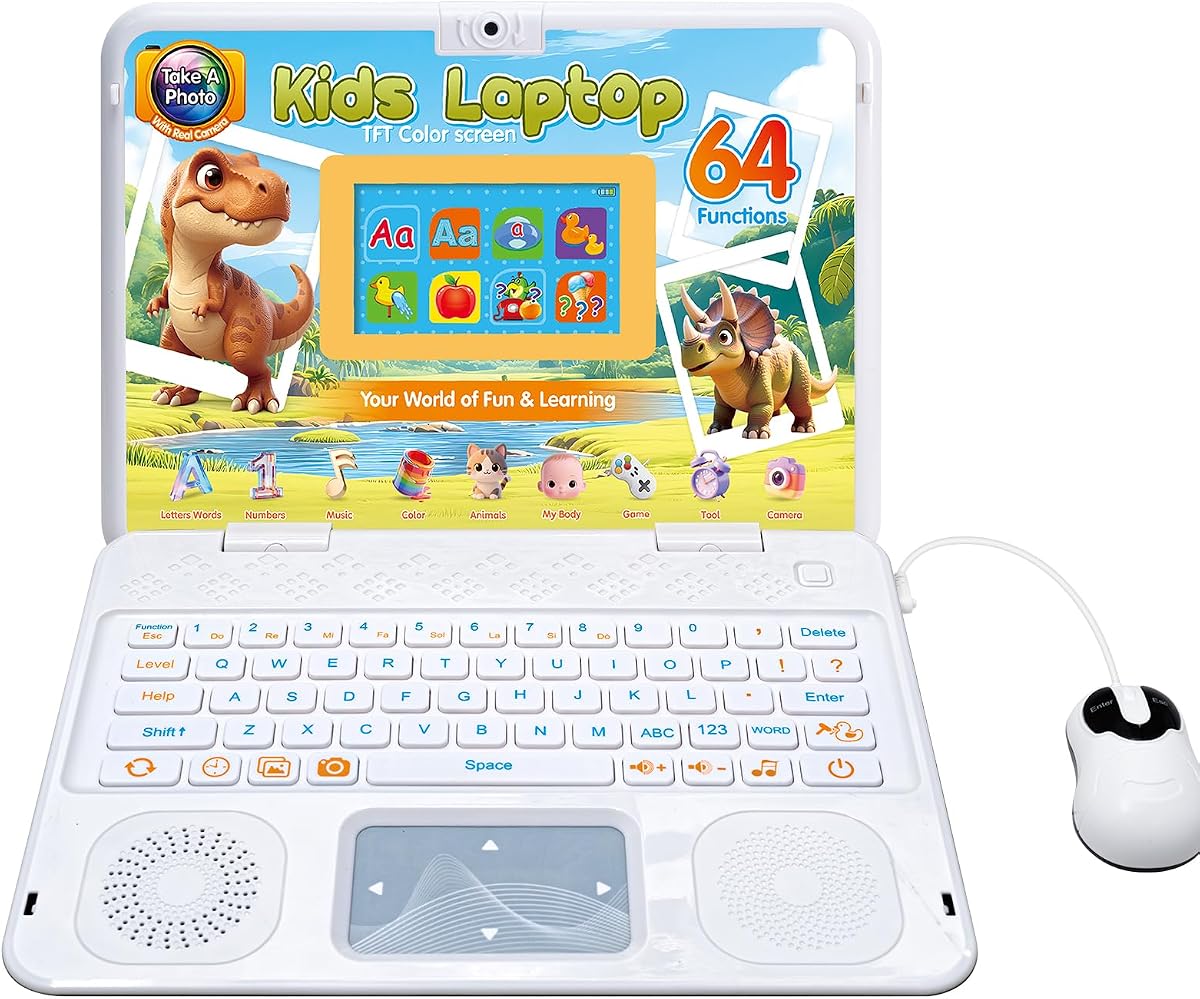
This laptop distinguishes itself with a built-in camera that encourages creativity through photography. It is an excellent tool for children who enjoy capturing moments and using digital art.
We may earn a commission when you buy through this link, at no additional cost to you.
With 64 activities covering alphabet, math, and music, it offers substantial educational value. The vibrant screen enhances the visual appeal, keeping children engaged for longer periods.
The camera quality is basic, suitable only for play, not serious photography. However, the fun filters and effects make it enjoyable for casual creative projects.
Best for children who value art and expression, this device balances learning with play. It is a practical choice for families seeking an educational toy with extra features.
The camera comes equipped with cute photo frames and filters, allowing kids to express creativity and record memories.
Its slender form is compact enough for an easy handgrip, ensuring comfort during extended play sessions.
We may earn a commission when you buy through this link, at no additional cost to you.
This mini netbook provides full Android functionality at an affordable price point. It allows access to Google Play apps which can be tailored for specific learning needs.
We may earn a commission when you buy through this link, at no additional cost to you.
The quad-core processor handles daily tasks smoothly, making it suitable for video calls or educational apps. It is incredibly portable, fitting easily into small bags for travel.
The low RAM may cause slowdowns with multiple apps open, but it is acceptable for single-purpose tasks. Build quality is standard for budget devices and may not withstand rough handling.
Best for families on a tight budget who need a functional computer. It offers more capability than a toy while remaining accessible in price.
Pre-installed with Android OS and GMS, you get direct access to the Google Play Store for apps.
Weighing only 1.76 lbs, this computer is designed for mobility, making it an ideal companion for students.
We may earn a commission when you buy through this link, at no additional cost to you.
Running Android 12, this laptop offers a flexible platform that can be customized with educational apps. It is designed for students who need a versatile device for various tasks.
We may earn a commission when you buy through this link, at no additional cost to you.
The IPS display ensures good visibility from different angles, helpful for collaborative learning. USB Type-C charging means it can use modern chargers, simplifying power management.
Battery life is average at 5-7 hours, which may require mid-day charging for heavy users. However, for typical usage sessions, it provides sufficient power.
Ideal for students who need to run specific Android apps. It balances basic computing needs with the flexibility of an open OS.
Equipped with Android 12.0, you can access Google Docs and the Play Store for a wide range of educational apps.
Naked weight of 0.75kg makes it easy to carry, providing full connectivity through multiple interfaces.
We may earn a commission when you buy through this link, at no additional cost to you.
This Lexibook laptop offers a unique design that appeals to many children, making learning more inviting. It combines standard educational activities with music, adding an artistic element.
We may earn a commission when you buy through this link, at no additional cost to you.
The realistic keyboard helps children learn touch-typing basics. The slim design makes it comfortable to hold and carry, ensuring a good user experience.
It is primarily a toy with limited functional depth compared to computers. However, its durability and focus on learning make it reliable for daily play.
Best for children who enjoy creative play and need a sturdy learning tool. It is a great way to introduce computer basics in a fun format.
Musical activities for the first step in music including notes learning, composing and playing melodies are included.
Fun activities with different levels to learn, test and improve one's knowledge keep the experience engaging.
We may earn a commission when you buy through this link, at no additional cost to you.
Selecting the right device requires considering sensory needs, educational goals, and usability features to ensure the tool supports rather than overwhelms your child.
Screen size impacts visual comfort and ease of use. Larger screens are better for detailed tasks, while smaller screens reduce distractions. Touchscreens offer intuitive interaction for those who prefer tactile feedback over a mouse.
Look for high-resolution displays with adjustable brightness to protect eyes and reduce sensory overload.
A full-size keyboard helps develop real-world skills, but keys should be spaced correctly to prevent frustration. For children sensitive to tactile input, a simplified keyboard might be better.
Ensure the input method aligns with your child's motor skills and preferences for efficient learning.
The quality of pre-loaded apps matters more than quantity. Choose devices with structured, predictable activities that match your child's developmental stage.
Opt for content that covers diverse skills like math, logic, and language to support broad learning goals.
Children with autism may interact with devices in unique ways. A sturdy build and spill-resistant design protect the investment from accidental damage.
Prioritize devices with reinforced corners and secure battery compartments for longevity.
Decide if internet access is necessary. Offline modes prevent unwanted distractions and ensure safety. If online, strong parental controls are non-negotiable.
Always choose devices that allow you to manage app access and screen time effectively.
Long battery life ensures uninterrupted learning without the need for constant charging. This is crucial for maintaining focus during longer sessions.
Check if the battery is removable or replaceable to extend the device's lifespan over time.
For families speaking multiple languages or supporting language development, bilingual capabilities are a significant benefit. They allow children to learn vocabulary in different contexts.
Select devices that offer clear audio pronunciation in both languages for accurate learning.
Volume control is essential for managing sensory input. Look for devices with easily accessible volume buttons and adjustable audio levels.
Headphone jacks can be helpful for focusing on audio content without disturbing others.
Begin by setting up the device in a quiet space to minimize distractions. Install any necessary educational apps and adjust settings like brightness and volume to match your child's sensory preferences.
Teach your child how to use the keyboard and touchpad through guided practice. Establish clear routines for when and how long they can use the device to maintain structure.
Regularly update the device if it has internet access and clean the screen with a soft cloth to maintain visibility. Keep the device charged or stored safely when not in use.
Key features include predictable interfaces, adjustable sound levels, and distraction-free modes. A large, clear screen and intuitive input methods help support learning without causing sensory overload.
Many toy laptops and some budget devices work entirely offline. Full computers usually require internet for updates and some apps, but offline modes can be enabled for safety.
Check product descriptions for educational levels and parental controls. Always review the pre-loaded apps before letting your child use the device independently.
Toy laptops are designed for rough handling but lack advanced features. They are durable for play but may not support serious educational tasks like writing essays.
Basic learning laptops are suitable for ages two to five, while full computers are better for ages six and up. Always consider your child's specific development level.
Use parental controls to set limits or rely on physical cues like turning the device off. Consistency is key to maintaining a healthy balance between learning and play.
Many educational toys offer visual and auditory feedback tailored to young learners. Full computers support assistive technology software for more specific needs.
Toy laptops simulate functionality with limited features for safety, while real laptops offer full computing power. Toys are safer for beginners, while real laptops grow with the child.
Choosing the right laptop depends on your child's age and learning goals. The VTech Genio and LexiBOOK offer strong educational value, while Chromebooks suit older students needing full capabilities.
Prioritize devices that offer a balance of safety, engagement, and durability. Focus on features that support your child's specific sensory preferences and learning styles.
Prices and features change often, so verify current specs before purchasing. The best device is the one that encourages confidence and joy in learning.